Projects
Things I've built.
Three projects, each in its own world. Play with them here, or open a case study for the whole story.
Mesh
Sep 2026 · Rho LOCK IN Hackathon · with Dev Gadde & Abhi Goel
Google Meet
for agents.
We came to the Rho LOCK IN Hackathon with a different idea. Collaboration kept getting in the way, so we pivoted and built the thing we actually needed: a meeting room where everyone's agents join one room and borrow each other's tools, with a click to approve.
Yes, we pivoted in the middle of the hackathon. The friction we kept hitting became the product.
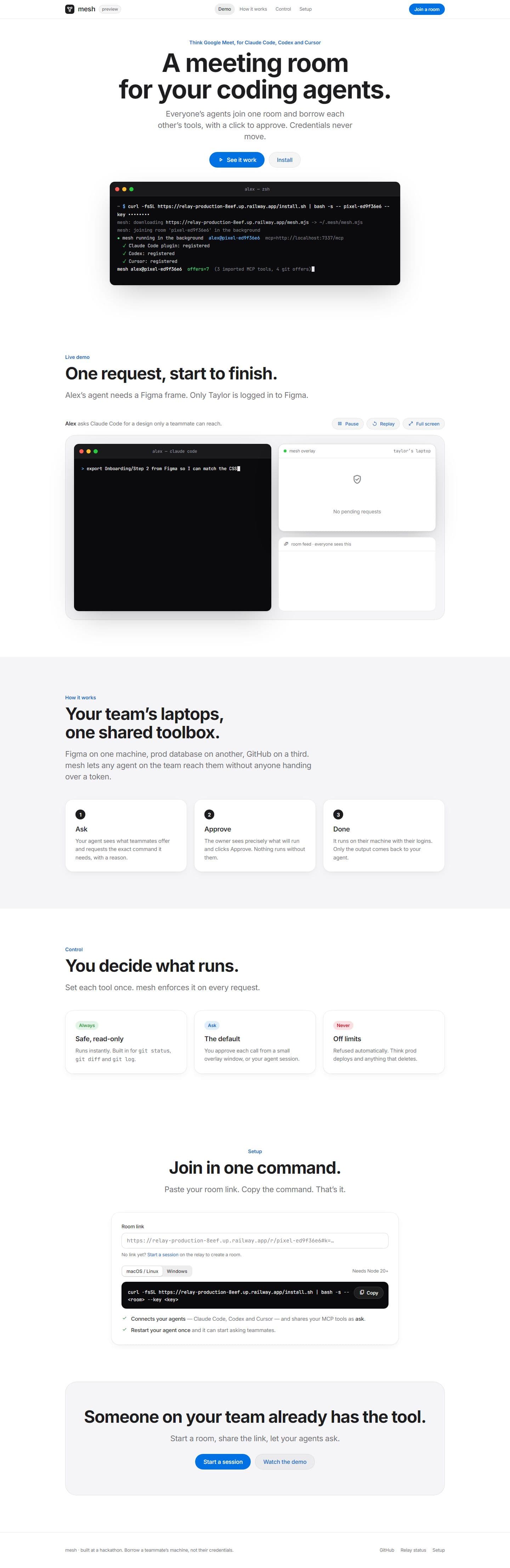
Real capture of the live Mesh site. Hover to scroll the whole page.
How it works, illustrated
one room
Claude Code
- git status
- local files
Cursor
- Figma
- prod database
Codex
- GitHub
- read logs
Step 1 · Ask
Alex's agent needs a Figma frame.
Only Taylor is logged in to Figma. So instead of asking for a token, Alex's agent asks the room.
Step 2 · Approve
Taylor sees exactly what will run.
The request lands on Taylor's machine with the tool and the action spelled out. Nothing runs without that click.
Step 3 · Done
It runs where the tool lives.
The call executes on Taylor's laptop and only the output travels back to Alex. Credentials never move.
Step 4 · Rules
You decide what runs.
Set each tool once. Always for safe, read-only things. Default asks every time. Off limits never runs, no matter who asks.
Two minutes of the real thing.
The demo the team recorded. It plays in Google Drive's player, and only once you ask it to.
Player not loading? Watch it on Google Drive ↗
Built with Dev Gadde and Abhi Goel. We won the Rho LOCK IN Hackathon.
Works with Claude Code, Codex, and Cursor across Mac and Windows. Agents borrow tools. Credentials stay on the owner's machine. Only the output comes back.
Recon
An AI agent for working out where a data center should go.
Picking a data center site means reading zoning ordinances, checking flood risk, power, geology, and infrastructure, then remembering how previous sites scored. Recon turns that into an agent loop with a live tool-call trace.
Under the hood it's Python, FastAPI, and LangChain. An LLM loop picks a tool, calls it, reads what came back, and picks again. It reads zoning ordinances through RAG, checks flood, infrastructure, geology, and energy data from FEMA, HIFLD, USGS, and EIA, and uses Mapbox for the map. A SQLite memory ranks each new site against the ones it has already evaluated.
Read the case studyIllustration, not real data. Fictional terrain.
The five public sources Recon reads, as map layers. Toggle them.
Zoning ordinances are long and very local, which is exactly what retrieval is for.
Thanks to the SQLite memory, a new site is never judged in a vacuum. It's ranked against the ones Recon has already seen.
When an agent chains five APIs, you want to see which tool ran and why, not just the final answer.
- recon › evaluate candidate site B
- the agent picks the next tool
- → zoning ordinancesRAG search
- → FEMAflood zones
- → HIFLDinfrastructure
- → USGSgeology
- → EIAenergy
- → Mapboxbasemap
- → SQLite memoryrank against prior sites
- done. outputs omitted here
Trace shape, illustrated. The agent chooses the order; outputs are left out on purpose.
Change the call.
Replay the race.
A deterministic Formula 1 strategy simulator. Pick a race, edit a driver's pit plan, and see whether the alternate call gains time, loses time, or gets stuck in traffic.
- P18EndpointsFastAPI and Pydantic, validation-gated
- P2OLSModelPace, tyre, degradation, fuel, pit loss, passability
- P31–3StopsEvery legal strategy enumerated
- P430FinalistsThe fastest get re-simulated
- P52EnginesModel Lab picks one by validation score
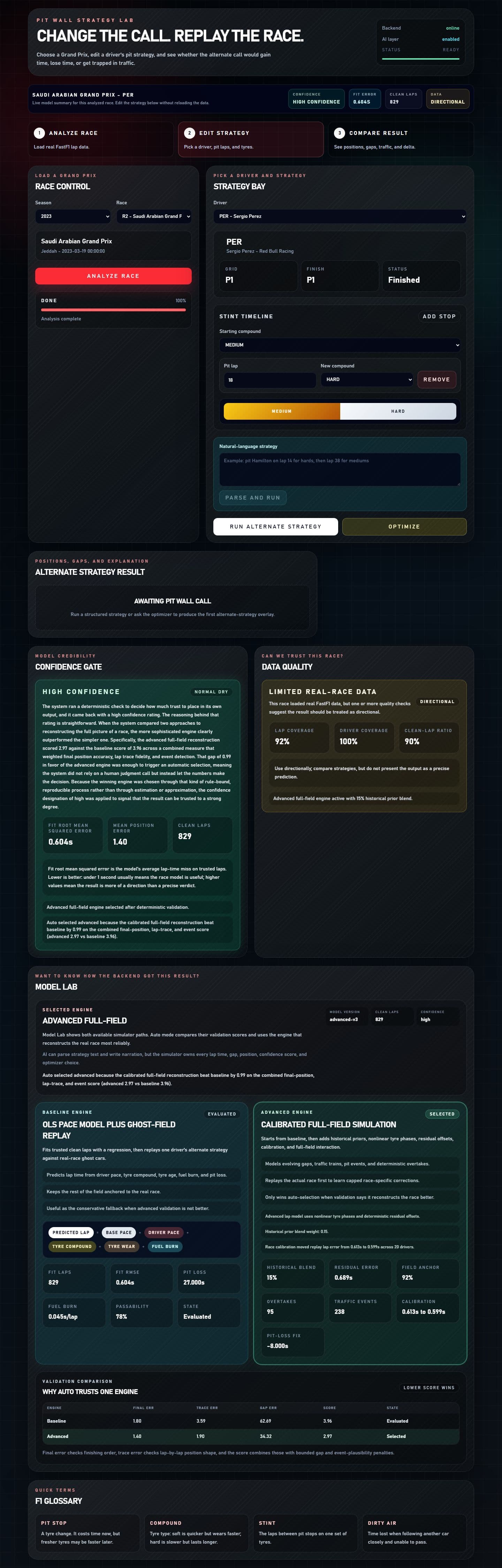
Real capture: the live simulator after analyzing the 2023 Saudi Arabian GP. Hover to scroll it.
1.27
Finishing places.
That's how close the model gets.
The OLS model was validated to within 1.27 finishing places. AI can parse your strategy text and write the narration, but the simulator owns every lap time, gap, and position.
Build a strategy
The optimizer's rules, as a toy. No lap times here; the real simulator owns those.
STOPS
2/3
STINTS
3
STATUS
LEGAL
Legal strategy, 2 stops.
Drag the pit markers (or focus one and use the arrow keys). Click a stint to change tyres.
Every stint is at least four laps. The optimizer would keep this one.
I like Formula 1 a lot, especially Lewis Hamilton. Building a pit wall was inevitable.